VMPL
New Delhi [India], October 8: When someone has a major heart attack in a small Indian town, the first hour usually decides whether they live. For years, that hour was lost getting the patient to a cardiologist who might be a district away. Since 2019, seven state governments have set out to close that gap, and the results are showing.
Across Goa, Telangana, Maharashtra, Odisha, Karnataka, Bihar and Manipur, government STEMI programmes run with Tricog Health's technology, and doctors now cover 167 districts, more than 3,000 health centres and a population of over 305 million. STEMI is the deadliest kind of heart attack, the one where a blocked artery is starving the heart of blood, and it kills fastest when treatment is delayed. The programmes are built on a plain idea. Put a digital ECG machine in the primary health centre where the patient first arrives, have a cardiac doctor read it within minutes at any hour of the day or night, and move the patient along an agreed treatment path before the heart muscle dies.
The numbers coming out of the states show what that does to survival.
In Karnataka, the time from a patient's arrival at the hospital to opening the blocked artery has fallen from 170 minutes in March 2023 to 65 minutes this May. The time to clot-busting treatment dropped from 34.5 minutes to 14.2. The programme has diagnosed more than 11,000 heart attacks and counts over 9,600 lives saved, more than nine a day. NITI Aayog has since declared the Karnataka programme as an AI-powered cardiac lifeline.
The clearest lesson across every state is also the hardest one. Patients who received reperfusion in time, the treatment that restores blood flow to the heart, survived at far higher rates than those who did not. In Maharashtra, in-hospital mortality was 3.9 per cent among patients treated in time, against 19.7 per cent among those who were not. The medicine is not new. Getting it to the patient before it is too late is the whole problem, and the whole point.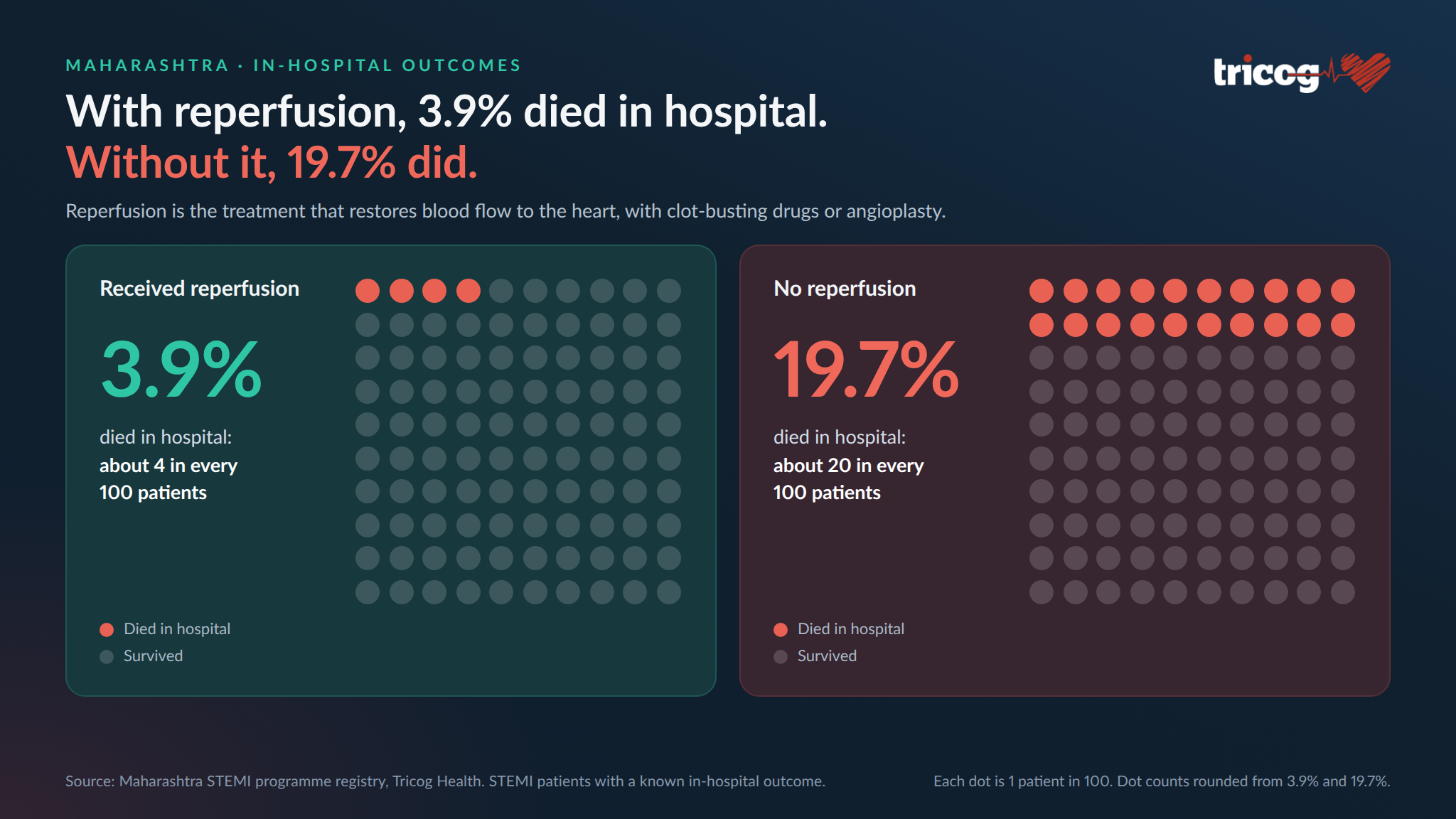
That is why the model leans on the district hospital and the primary centre rather than the distant tertiary one. Maharashtra now reaches all 34 of its districts down to the community and primary health centre level, has trained more than 22,000 health workers and has read close to five million ECGs. Its overall STEMI mortality has come down from 20 per cent to 15.5 per cent. In Odisha, survival among enrolled patients rose from 79 per cent in August 2025 to nearly 88 per cent by March 2026, and the programme reckons it is saving around twelve lives a day.
Goa is where it began in 2019, and it remains the reference case, partly because outsiders have assessed it. A review commissioned by the Union health ministry and carried out through the Population Research Centre in Dharwad found the programme was delivering treatment within about fifteen minutes, well inside the ninety-minute window the assessors used as the benchmark for timely care. It concluded that a STEMI programme built on existing staff and primary health infrastructure could serve as a model for widening reperfusion care in a resource-challenged country. Today, the Goa programme has logged more than 460,000 diagnoses and caught over 22,000 major heart attacks, still picking up a critical case in an average of three minutes.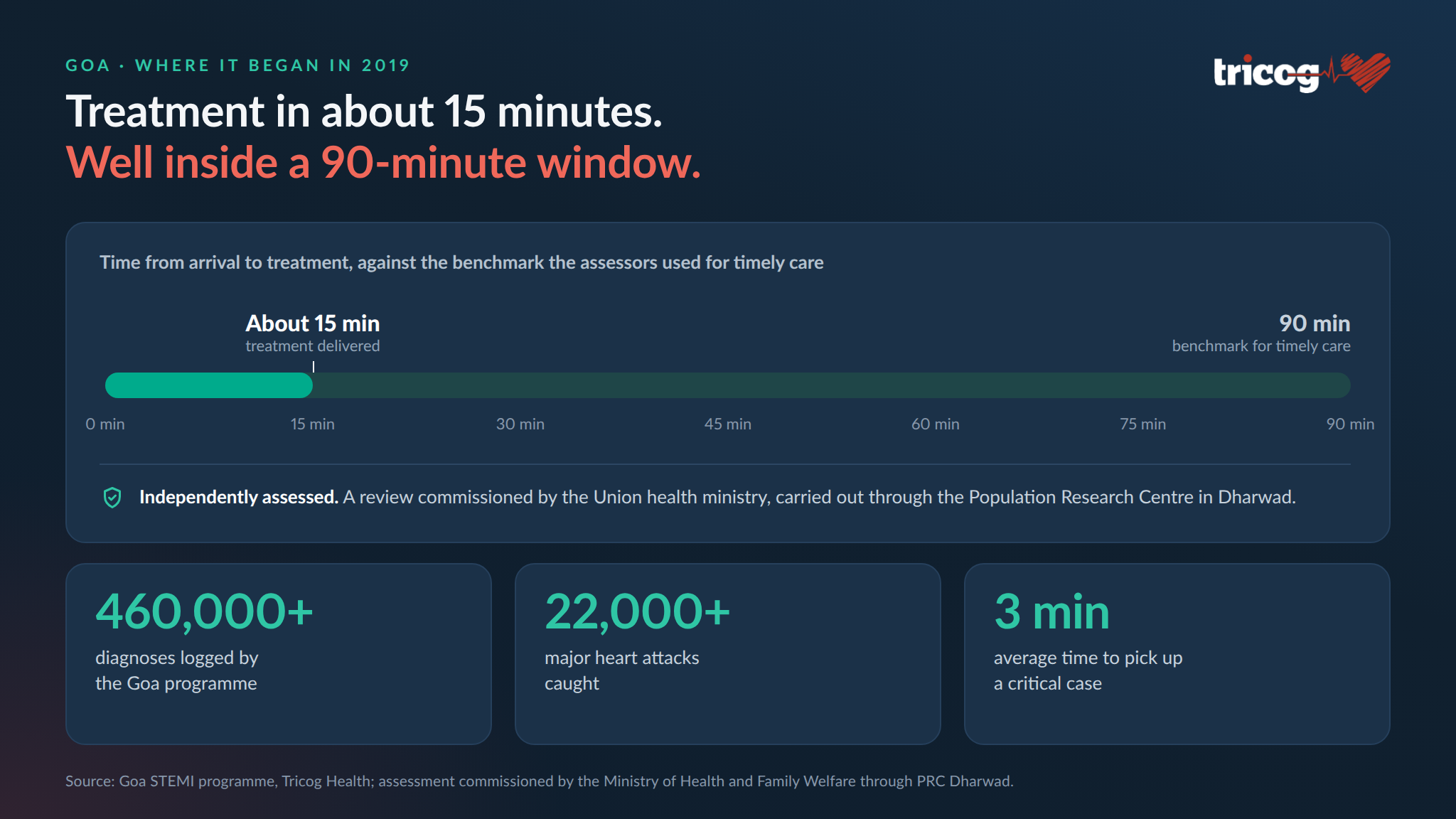
None of this means the job is done. Most of the patients who still die do so because they received care too late, and that is the hardest thing to shift. Close to a third of these heart attacks happen at night or over a weekend, so a spoke that only runs in daytime hours is no help to those patients. Someone has to be able to reach a doctor and get clot-busting treatment started at two in the morning. Other gaps are more mundane: Referral forms get skipped, ambulances aren’t always plugged into the chain, and a patient's phone number often never makes it onto the record, leaving no way to follow up. As the programme's own review noted, the machines go in far quicker than the habits around them change.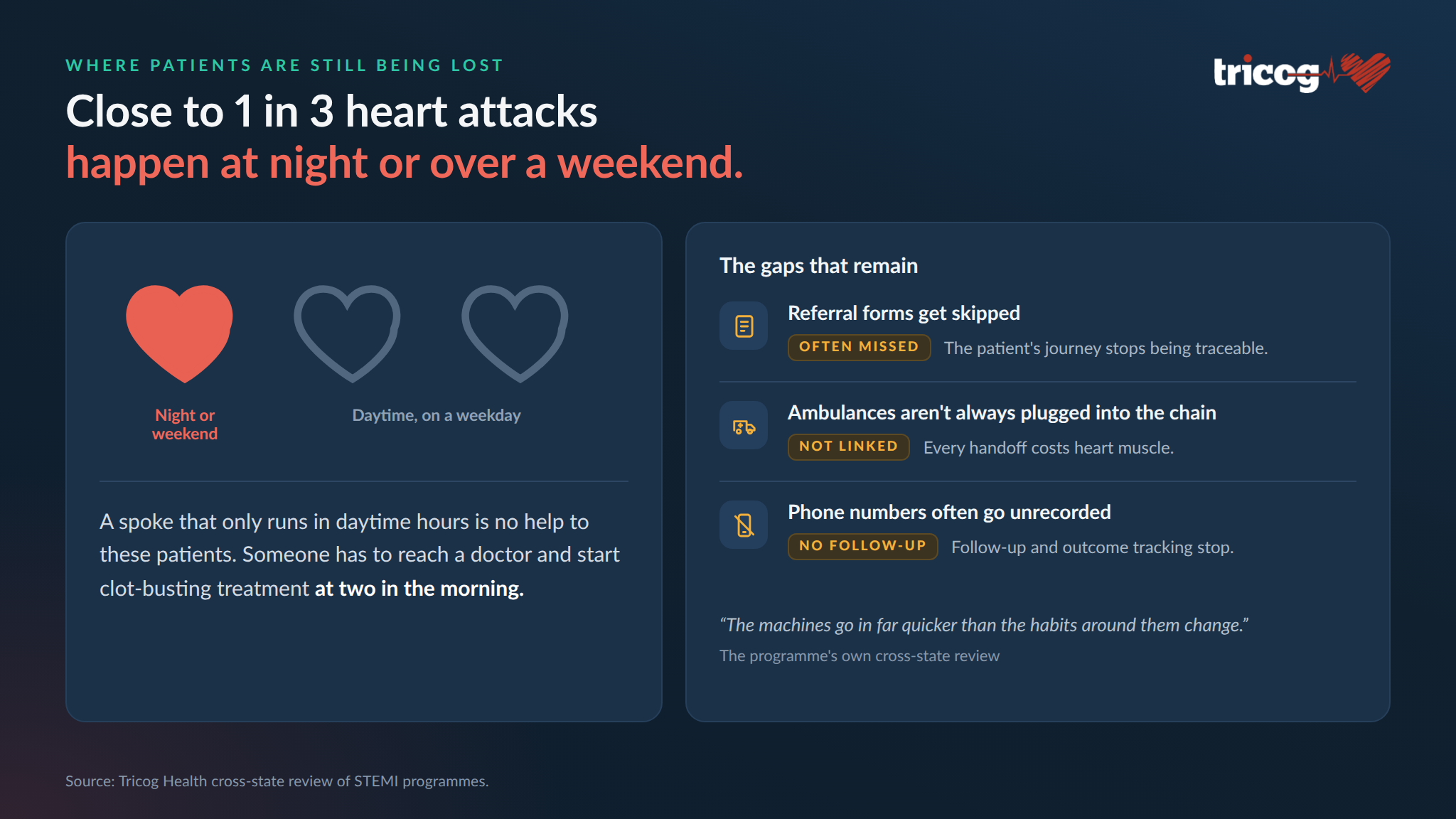
All of this feeds straight into what was being discussed at the National CVD Summit. The point made there, more than once, was that India largely knows what good cardiovascular care looks like; the difficulty is delivering it consistently everywhere, and awareness campaigns alone don't achieve that. The seven-state STEMI programme is one of the few places where that harder work has actually been done. The state runs the pathway, from the first ECG at a spoke through to treatment along a set route. The AI does the first read, but a Tricog doctor signs off on every case. It also tracks outcomes closely enough to see where patients are still slipping through.
“A heart attack in a district town should not carry a worse sentence than one in a city,” said Dr Charit Bhograj, Founder and CEO of Tricog Health. “What these seven states have shown is that when the government owns the pathway, and the first ECG is read by a doctor within minutes, survival changes. The technology is ready. The work now is making sure no patient reaches us too late,” he added.
Cardiovascular disease is India's biggest killer, and ischaemic heart disease is its sharpest edge, making up an estimated 40 to 60 per cent of acute coronary cases in the country and carrying a higher in-hospital death rate than other heart attacks. Based on evidence from these seven states, building reliable STEMI systems is one of the most direct ways to reduce that number.
About Tricog Health
Founded in 2014 by interventional cardiologist Dr Charit Bhograj, Tricog Health is an AI-powered cardiac care company that combines connected medical technology, artificial intelligence, cloud infrastructure, and clinical expertise to enable faster detection and management of cardiovascular disease. Tricog's platforms have screened 41M+ patients, identified 500K+ heart attacks and flagged over 1.5M critical ECG findings. Its technology supports 12K+ customers across 15K+ installations spanning hospitals, clinics, diagnostic centres, and public health programmes, including large-scale collaborations with various state governments across 12+ countries.
Tricog Health: https://tricog.com/ | Accelerating Cardiac Care
(ADVERTORIAL DISCLAIMER: The above press release has been provided by VMPL. ANI will not be responsible in any way for the content of the same)